
A-Spec As-Constructed Submissions in Victoria: What Councils Require Before They Accept the Assets
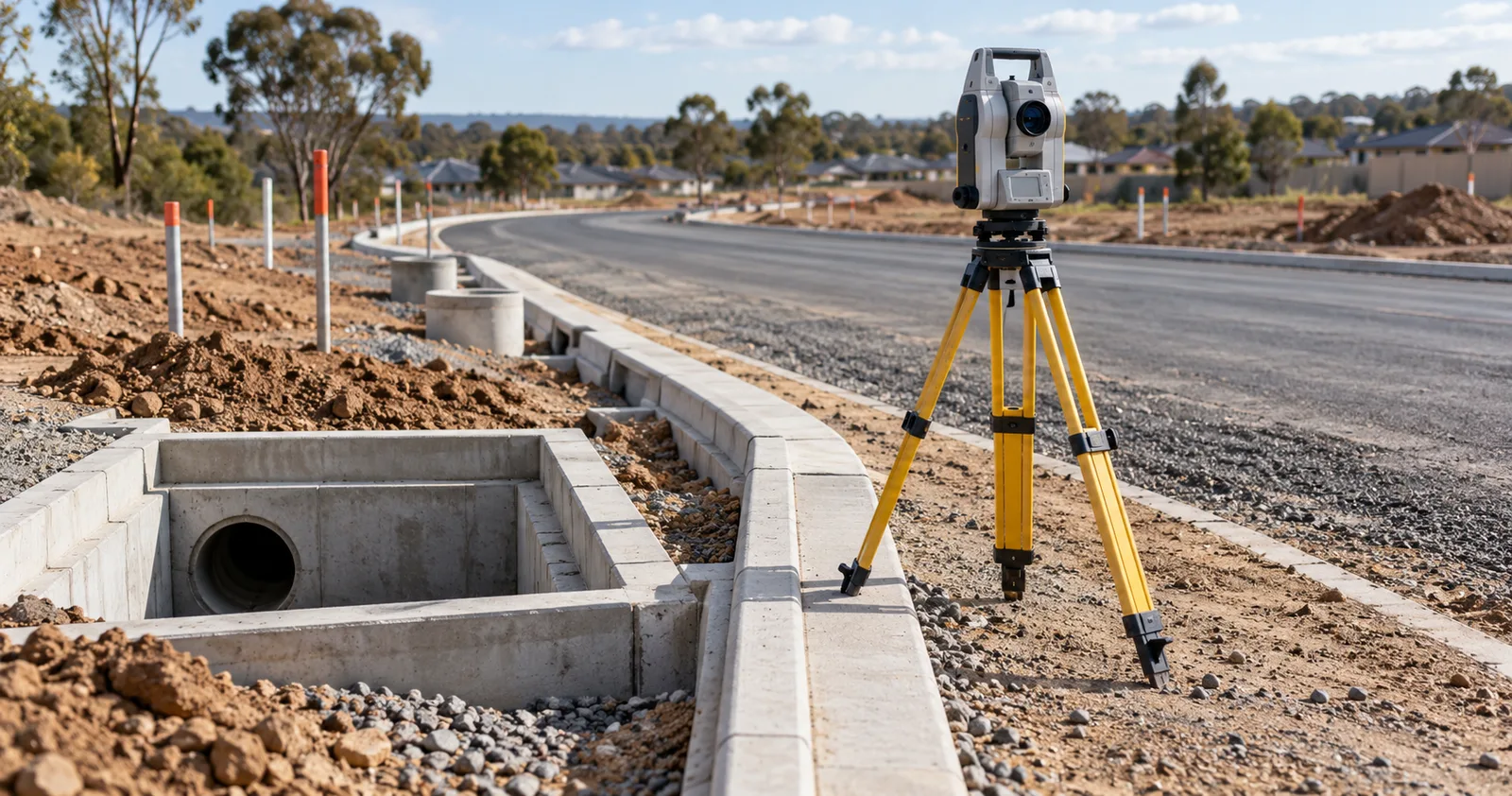
A subdivision can be finished on the ground and still not be finished on paper. Victorian councils can require as-constructed data in a format their asset systems can read before a project’s completion milestone is cleared.
The requirement is not unusual and it is not new. What catches projects out is that it involves several parts: the specification, the authority’s template or delivery format, its submission system and the applicable codelist. These need to agree with the receiving authority’s requirements.
This guide uses Melton City Council and the City of Greater Dandenong as examples. Both require A-SPEC submissions through ACDC using their own templates. Other asset owners may specify a different system or delivery format; GISSA’s A-SPEC guidance lists ACDC, GDV Hub and proprietary systems among the options. Confirm the requirements for the authority taking your assets.
The short answer
- Establish which A-Spec specifications apply to the assets, including R-Spec, D-Spec and O-Spec where required.
- Obtain the authority’s required template and delivery instructions before anyone goes to site.
- Confirm the specification release and applicable codelist version with the authority.
- Capture assets during construction, before they are covered where that is needed to measure them.
- Submit through the authority’s nominated system. For Melton and Greater Dandenong, this is ACDC.
- Treat portal validation as a machine check, separate from acceptance.
- Confirm the submission milestone and allow for it in the programme.
1. Establish which specifications apply
A-Spec is a family, not a single document. It is managed by GISSA with a community of infrastructure managers across Australia and New Zealand. The modules split by asset type:
- R-Spec — the authority’s assets within the road reserve
- D-Spec — drainage assets: pipes, pits, property connections and WSUD elements
- O-Spec — public open space and recreation assets
- S-Spec and W-Spec — sewerage and water assets, where required by the asset owner
- B-Spec — building assets
A residential subdivision may require R-Spec and D-Spec. O-Spec may apply as well where there is a reserve, a park or landscaped open space. Confirm the required modules against the authority’s brief.
Settle how many asset owners are involved as well. A council and a water authority may require separate submissions, different systems and different timetables. Confirm each owner’s requirements at the start.
2. Get the council’s template before anyone goes to site
Using the wrong template can create avoidable rework.
For councils using ACDC, the council-specific template is part of the submission requirement. Melton City Council states that its template “is specific to Melton City Council”. The City of Greater Dandenong also requires its own ACDC AutoCAD A-Spec template. Do not assume these are interchangeable.
For those jobs, work to the council’s required template and version as well as the A-Spec specification. A package built against another authority’s template, or an outdated version, may need to be corrected before it can proceed.
Obtain the required template at the start, rather than at handover.
3. The codelist version is a separate fact
A specification describes the asset information and geometry required. A codelist supplies the codes used to describe assets. Confirm both the specification release and applicable codes with the receiving authority.
GISSA’s guidance on the Harmonised Codelist explains that it supplies standard codes for newly created assets, while some codes used in Existing Assets specifications may not appear in that list. Check which requirements apply to the work you are doing.
Record the agreed versions with the project and confirm any uncertainty with the authority’s asset team before capture. This gives the survey and export teams the same reference when preparing the submission.
4. Capture during construction, not after
Drainage is the clearest case. Pit dimensions, pipe inverts, connection points and WSUD elements are straightforward to record while they are exposed. Once backfilled and sealed, some details can be difficult or costly to verify. The same issue applies to service crossings and assets under pavement.
An as-constructed survey booked after practical completion may have limited access to hidden features. Further investigation, exposure or supporting records may be needed. Identify anything that has not been measured directly and agree how it will be verified with the asset owner.
The fix starts with scheduling. Capture at the stages where the asset is exposed, and treat those visits as programme items rather than an afterthought.
5. The portal is the gate
Melton and Greater Dandenong require submissions through the Open Spatial ACDC portal. It is a self-service site that validates as-constructed CAD drawings, manages project documentation, and prepares GIS data for loading into the council’s GIS and asset management systems. See the Melton submission instructions and Greater Dandenong submission instructions for each council’s process.
Both councils describe a one-time account registration followed by linking the account to the project. The submission uses that council’s template. The portal returns validation feedback so errors can be checked and corrected. Other authorities may nominate a different submission system.
What matters is who is set up on it, and when. Arrange the account, project link and required template before the data is ready, so setup does not become an extra task at the handover milestone.
6. A validation pass is not acceptance
The distinction matters when planning the submission.
Validation is an automated check against the configured requirements. Depending on the system, checks can cover file structure, codes, attributes, geometry and coordinate information. A pass means those checks have been satisfied.
Acceptance is a separate decision by the asset owner, following its review of the submission and any other project requirements.
A submission can pass validation and still raise questions on review. Automated checks do not replace verification of what was built or establish that every project condition has been met. Plan for both steps. A clean validation supports review; it does not determine acceptance or its timing.
7. Where it sits in the programme
Melton City Council requires the as-constructed data before a certificate of Practical Completion or Statement of Compliance is issued. Greater Dandenong requires it before a certificate of Practical Completion is issued.
Those requirements can place the work on the critical path. Allow time to capture the data through construction, assemble the package, validate it, correct returned errors and complete the authority’s submission and review process. Confirm the exact milestone and acceptance conditions against the project’s permit, contract and authority instructions.
Illustrative pre-capture worksheet
| Item | Example answer | Confirm with |
|---|---|---|
| Asset owners | Council (roads, drainage, reserve); water authority (sewer, water) | Planning permit, approved plans |
| Specifications | R-Spec, D-Spec, O-Spec | Council as-constructed page |
| Council template | Authority-specific ACDC AutoCAD template, where required | Authority’s submission instructions |
| Codelist version | Recorded at project start, in writing | Council asset team |
| Coordinate system | MGA2020 Zone 55, AHD | Design set and council requirement |
| Portal account | Created and linked to the project, where required | Authority’s nominated portal |
| Capture stages | Drainage open, pre-kerb, pre-seal, practical completion | Construction programme |
| Milestone | Before Practical Completion / Statement of Compliance, as required | Permit, contract and council as-constructed page |
Illustrative only. The values show the form each answer takes, not figures from a project.
Pre-submission checklist
Scope and ownership
- Every asset owner on the project identified, not only the council
- The specifications each owner requires, confirmed against its own published page
- Separate submissions planned where required by the asset owners
Template and codes
- The authority’s required template and delivery instructions obtained at the required version
- The specification release and codelist version confirmed and recorded with the project
- Codes used on site checked against the applicable specification and codelist
Capture
- Capture visits scheduled at the stages where assets are exposed
- Drainage recorded before backfill where needed to measure the required details
- Coordinate system and datum agreed and consistent across the set
Submission
- Portal account created and linked to the project before completion, where required
- Package checked and validation errors addressed through the nominated process
- Programme allowing for the authority’s review after validation, not only for validation
Common submission mistakes
Treating the specification as the whole requirement
The specification, the authority’s delivery instructions, the required template and the applicable codes all matter. Confirm the complete submission requirements rather than relying on the specification release alone.
Booking the as-constructed survey after practical completion
By then, drainage and other features may be buried. Capture during the exposed stages wherever possible and agree how any missing or inaccessible information will be verified.
Assuming one submission covers every asset
Where a water authority owns the sewer and water assets, it may require a separate submission and access arrangements. Check its process and timetable alongside the council’s.
Reading a validation pass as acceptance
It is an automated check against configured requirements. The asset owner’s review is a separate step and a separate decision.
Leaving the portal account until the end
Account creation, project linking and template access can add avoidable delay if left until a submission milestone is due. Confirm access early with the authority.
Letting the coordinate system drift
Validation may flag coordinate-system errors, but it cannot replace checks on the survey control and export. Agree the datum and projection at the start, and verify that the observations and delivery files use them consistently.
What to send with an as-constructed enquiry
To scope the work properly, the useful information is:
- The authority or authorities taking the assets, and the permit or project reference
- The approved design set, and the IFC drawings where they have moved on
- The construction programme, so capture can be scheduled against the open stages
- Any survey control already established on site, and the coordinate system in use
- The council’s as-constructed page or template, where it is already to hand
- The milestone the submission has to clear, and when it is expected
HR Surveyors delivers as-constructed capture and A-Spec and ADAC submissions for civil, subdivision and infrastructure projects in Victoria and nationally. Our Specification Surveys (A-SPEC & ADAC) service covers capture, validation and lodgement to the receiving authority’s requirements.
Contact HR Surveyors to scope an as-constructed handover against a council’s requirements, or to review a package that has come back with errors.
Sources
- A-SPEC standards and specification modules — GISSA and the A-SPEC Community, accessed 23 October 2026.
- A-SPEC specifications, codelists, delivery formats and validation systems — GISSA’s A-SPEC FAQs, accessed 23 October 2026.
- A-SPEC Specification requirements and the ACDC portal — Melton City Council, accessed 23 October 2026.
- A-SPEC as-constructed submission requirements — City of Greater Dandenong, accessed 23 October 2026.